Article by NTVScout: Matias Deya
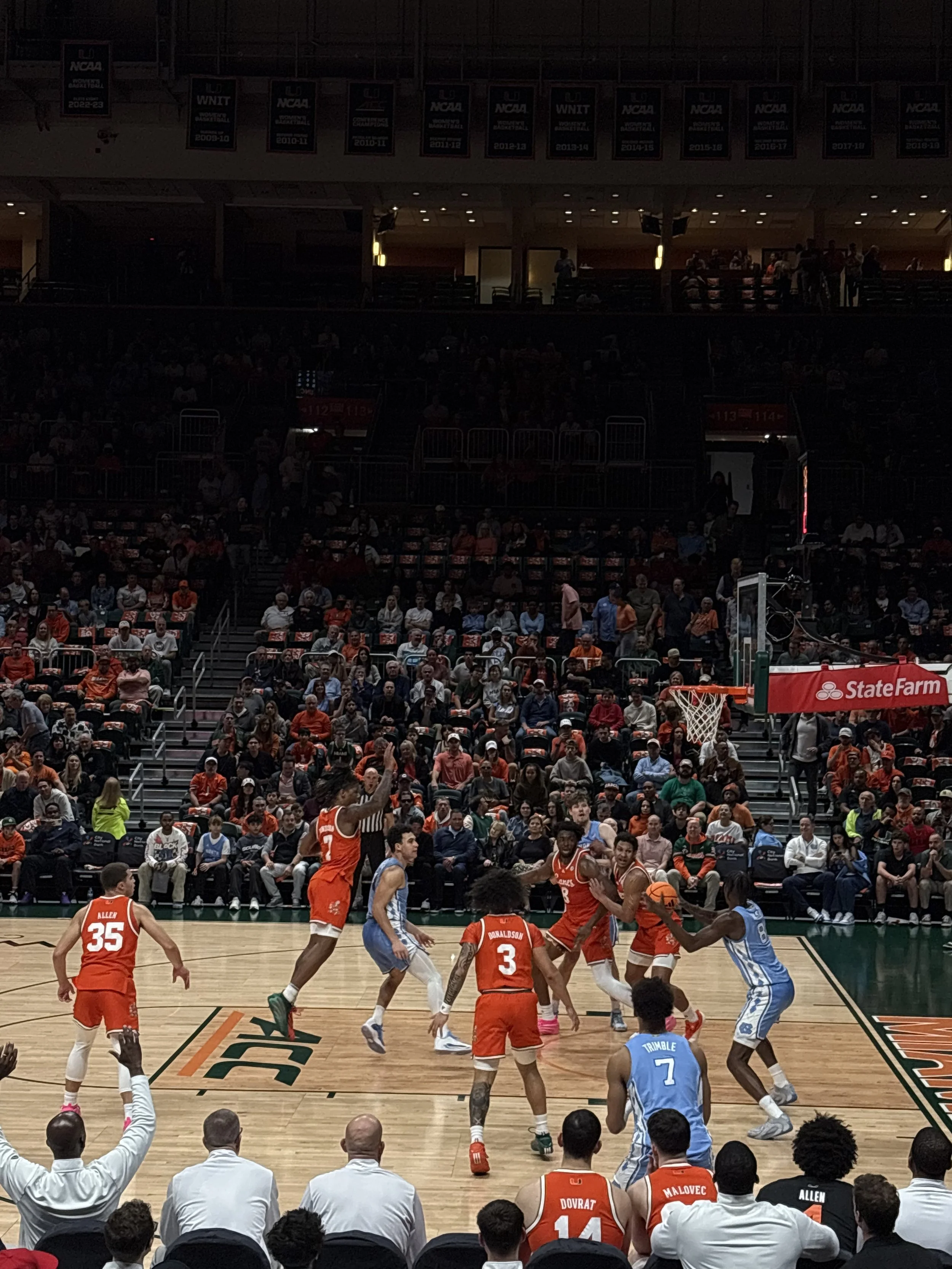
University of Miami vs UNC Game Report
Final Score: Miami 75 – UNC 66
Date: February 10, 2026
Miami delivered a poised and structured performance to defeat North Carolina 75–66 in a game they controlled from start to finish. Despite UNC’s perceived talent edge, the Hurricanes’ discipline, defensive versatility, and execution ultimately defined the outcome.
From the opening 10 minutes, Miami looked like the more organized team on both ends. UNC committed at least four careless turnovers early, while Miami valued possessions and dictated tempo. Shelton Henderson set the tone immediately, attacking the rim with aggression and finishing through contact. He played with visible edge and physicality, establishing himself as a consistent downhill presence.
Even with Miami executing more cleanly, UNC’s perimeter shooting kept the game competitive. Late in the first half, the Tar Heels were 6–11 from three compared to Miami’s 3–7, and the deficit remained minimal. At halftime, Miami led 43–40 — a three-point margin that felt reflective of execution versus raw talent. Miami played more cohesive basketball; UNC relied more heavily on individual playmaking.
A major separator was the turnover battle. Miami finished with just 8 turnovers, while UNC had 11, including 8 in the first half alone. That possession margin, paired with Miami’s 47% shooting from the field (compared to UNC’s 40%), prevented North Carolina from ever gaining control. In fact, UNC never held a lead in the game, often trailing by five or fewer points but failing to capitalize in key moments. Each time the opportunity arose, they settled for contested perimeter shots rather than attacking the zone with force.
Defensively, Miami impressed with its adaptability. The Hurricanes frequently operated out of a 2–3 zone that seamlessly shifted into a 1–3–1 alignment, at times placing a guard in the middle to disrupt passing lanes. UNC struggled to generate consistent interior pressure against it, and the lack of structured counters allowed Miami to stay organized and composed.
Caleb Wilson, the freshman 6’10” forward widely projected as a top-five pick, finished with 12 points on 4–10 shooting, along with 6 rebounds and 3 blocks. While not a dominant offensive outing by his standards, Wilson flashed the defensive timing and instincts that make him elite. His chase-down block ability and weakside rim protection were evident. However, there were moments where his lateral stance and perimeter containment could improve — particularly when Miami attackers beat him off the dribble, forcing help rotations that led to open finishes. His long-term projection remains extremely high, but this performance showed that refinement on-ball defensively will elevate his overall impact.
Jarin Stevenson was one of UNC’s more impressive performers on the night, finishing with 13 points on 6–10 shooting and 6 rebounds. At 6’10”, his size stands out immediately, but what was most intriguing was his ability to handle the ball effectively on aggressive drives. He displayed comfort attacking downhill and showed coordination that suggests untapped upside beyond his current statistical profile. Based on this performance alone, Stevenson warrants closer long-term evaluation.
Luka Bogavac contributed 6 points on efficient perimeter shooting (2–3 from three) and continues to profile as a movement shooter. His mechanics are clean, and he relocates well off the ball to find space. However, his game remains heavily shooting-dependent. Limitations in ball handling, defensive versatility, and playmaking currently cap his overall impact, though his size at 6’6” gives him positional flexibility between the two and three.
Ultimately, four of Miami’s five starters scored 12 or more points, reinforcing how balanced and connected their attack was. This was not a win built on individual brilliance, but on cohesion, defensive structure, and possession discipline. For UNC, it was a frustrating loss, close throughout, yet never within their control.
Miami’s 75–66 victory was a clear example of team execution outweighing individual talent.